Here is everything that I plan to do with my Masters class for week 10 in cycle 3 of Classical Conversations!
CC Cycle 3 Week 10 Memory Work
CC Cycle 3 Week 10 Timeline
This week for timeline, I plan for us to play Reptile Catcher.
This game has two variations and has basically an unlimited amount of character options. It is similar to the bomb game I have seen for CC timeline ideas.
What you will want to do is have six reptile print outs & one reptile catcher print out.
Tape six of the reptiles onto the back of six timeline cards.
Tape one reptile catcher on the back of one timeline card.

Here are the two ways you can play:
- Good Guy – in this version, the reptile catcher is a good guy who is saving the most amount of reptiles that he can. Your class will want to guess the reptile catcher sooner than later, ideally first, to save more reptiles than reptiles that are lost. You will sing the timeline song, have a student pick a card, flip it over to reveal, then repeat 6x.
- Bad Guy – in this version, the reptile catcher is a bad guy who wants to bring the reptiles to the sanctuary. Your class needs to rescue as many reptiles as possible, i.e. flip over all the reptiles before the reptile catcher is flipped over.
If you have a younger or more sensitive class, you can always say at the end something like, “Good news! I just received a call that all the reptiles escaped on the ride to the sanctuary.”
If you want to keep this “stick in the sand,” instead of printed pictures, just use a sticky pad to write “reptile” or “reptile catcher” on the cards.
I get my pictures from Canva and then laminate them to use for future years. Or in my case, I used them last year and will use them again this year.
Supplies needed to play Reptile Catcher:
- 7 Timeline cards pertaining to the week
- 6 reptile pictures and 1 reptile catcher picture & tape (or 7 sticky notes with the words “reptile” or “reptile” on it)
Approximate time it takes to play Reptile Catcher: 5 minutes
CC Cycle 3 Week 10 Math
For the Masters class, I like to do minute-to-win it type of games or mathercise.
This week, we played Yahtzee, which is basically a minute-to-win-it game.
This game works best for a class of seven students or less. If you have eight students, have the first two students go at the same time, then one student at a time after that so that there are only seven repetitions.
If you have less than seven students, do one for each student and then you can either just say the facts quickly for the remaining repetitions or hold competitions between the top competitors.
To play Yahtzee, give one student (or two, see note above) five dice. Have the rest of the class recite the math fact one time through while the person with the dice plays.
The student with the dice needs to roll for all of the same number on the dice. We will recite the squares, so roll for 2s.
Say they roll 5 dice, and they get two 2s. They keep the two 2s up, pick up the remaining 3, and keep trying for 2s.
You can make it more difficult by adding more dice or just see how many Yahtzees they can get.
The person stacking does not do the recitation.
Continue playing with each student and see who can get a Yahtzee!
Supplies needed to play Yahtzee:
- five dice
Approximate time it takes to play Yahtzee: 6 minutes
CC Cycle 3 Week 10 History
As usual, we will play Hot or Cold.
To play Hot or Cold, listen to the history song one time all together. Then, show the class the item you will be hiding.
This week, we will hide something that is red/white/blue. I basically just saved a bunch of 4th of July party favor type items to cycle through this year.
Have one parent bring the chosen student outside into the hallway while the rest of the class chooses a place to hide the item.
Once hidden (tip – only give them 30 seconds so it’s not a big time suck), invite the student back in. Have the class sing the history song loudly if the student is close to finding the object and quietly if the student is farther from the object.
The student has six repetitions to find it. If they find it in time, they win, if not, the class wins. If the student finds in before six repetitions are over, have everyone sing or say the history song as fast as they can for the remaining repetitions.
Supplies needed to play Hot or Cold:
- Object to hide
Approximate time it takes to play Hot or Cold: 5 minutes
CC Cycle 3 Week 10 Latin
This week, I plan to do a song that spans weeks 9-11 to cover Latin rules.
This song is by Gabriela Gierke and goes to the tune of Yankee Doodle, fitting for our tin whistle song this cycle.
To get in the 7 repetitions:
- Read the rule.
- Introduce the song.
- Sing all for the remaining repetitions.
Supplies needed for Latin:
- none
Approximate time needed for Latin: 2 minutes
CC Cycle 3 Week 10 Science
This week I plan to introduce hand motions by Stephanie Laughlin on YouTube.
Here is the order I plan to do to get all seven repetitions in:
- Read the question and say the answer, making sure to say “Some parts of the respiratory system are…”
- Read the question and have the class answer
- Introduce the hand motions to the class
- Everyone does the hand motions for the remaining repetitions
Supplies needed for science: none
Approximate time needed for science: 4 minutes
CC Cycle 3 Week 10 English
This week we will use the hand motions we have learned so far to recite the different verb tenses for “to lie.”
Here is the song and hand motions that I will use by Driven By Grace which goes to the tune of If You’re Happy and You Know it:
If the song is just too much on top of the hand movements, we might just chant it. I’ll see what the class wants to do/can handle given our quick time frame!
Here are the 7 repetitions:
- Read the grammar.
- Introduce the hand motions for each part.
- All practice the hand motions for each part.
- Introduce the song (or do a chant) while doing the hand motion.
- Have the students sing with me (or do a chant) and do the hand motion for the remaining 3 repetitions.
Supplies needed for English: none
Approximate time needed for English – 4 minutes
CC Cycle 3 Week 10 Geography
This year we’ve been trying something new in my Masters class and it went really well!
This is the last week we will work on these maps, then we will transition to something different.
Instead of tracing maps, I want to challenge my class to draw the US, week by week.
My director gives us large copies of the CC maps, one for each student. Last year, the students traced the maps.
I picked up some 11×8.5 paper. I plan for each student to keep their map all year (in a folder I will take home each week) and to build on the map each week.
Here is what I plan to do to get our seven repetitions in:
1. Read the states and capitals for the week while the students put their names on their papers.
2 & 3. Have the students draw just the states we are doing this week, with their dots for capitals, on their papers while I read the states and capitals 2x through.
4. Show me where _____ is… (all 5 locations)
5. Tell me what this is… (all 5 locations) as I point to my map on my board.
6 & 7. Everyone reads all the states & capitals while passing their maps back to me to put away for next week.
Supplies needed for geography:
- large map for each student
- 14×8.5 paper for each student
- pencil for each student
- optional – Draw the USA by Kristin J. Draeger to reference if students are stuck – she blobs the shapes of each state to make it easy to draw
Approximate time needed for geography: 5 minutes
CC Cycle 3 Week 10 Tin Whistle
This week for tin whistle should move pretty quickly for my Master’s students, as we have been discussing this all quarter while topics came up as we practiced playing Yankee Doodle.
I plan to follow the Foundations guide (pages 96 & 97) but switch the expressing section to the last section rather than the second.
This way we can do all of the naming/defining and paperwork while our tin whistles are still napping in their backpacks ;).
Supplies needed for week 10 tin whistle:
- each student needs to bring their tin whistle (give students a pencil to finger along if they forgot their whistle at home)
- paper and pencil to draw the staff and rhythm copy notes
CC Cycle 3 Week 10 Science
This week we will continue our anatomy study.
We will tackle the intestines, liver, lungs, and skin.
Encourage the students to color different body parts at different times so not everyone will need the same colored pencil at the same time.
I plan to inform everyone to label all of their parts with their names so I can keep everything together in my expandable file folder.
I will likely follow the script from my director this year since she outlines it nicely with Naming, Attending, Memorizing, and Expressing.
(Here is the script from my director by Tiffany Pena)
But I also plan to have the students review science grammar from what we already know.
The My Body book also has good information in it for teaching on each body part.
Supplies needed for hands-on science:
- My Body copies of the intestines, liver, and lungs
- Pencils
- Scissors
- Colored pencils, crayons, or markers
CC Cycle 3 Week 10 Presentations
This year, I plan to have a skill of focus each week.
For the tenth week, I plan to have the audience members practice the skill of asking open-ended questions.
I will inform the audience members to remember to wait until the presenter is done presenting to raise their hand for questions.
Then, they should ask questions with these starting words:
- What
- Why
- How
I am not including who, where, or when as a starting word since these words tend to have close-ended answers. (Who? this person Where? here When this time)
It’s not that we want to start long conversations during presentation time, but this will hopefully allow audience members to really think about what they want to know and not ask simple questions they probably already know the answer to if they thought about it longer.
I plan to just print off the words what, why, and how onto pieces of paper for each student to reference.
CC Cycle 3 Week 10 Review
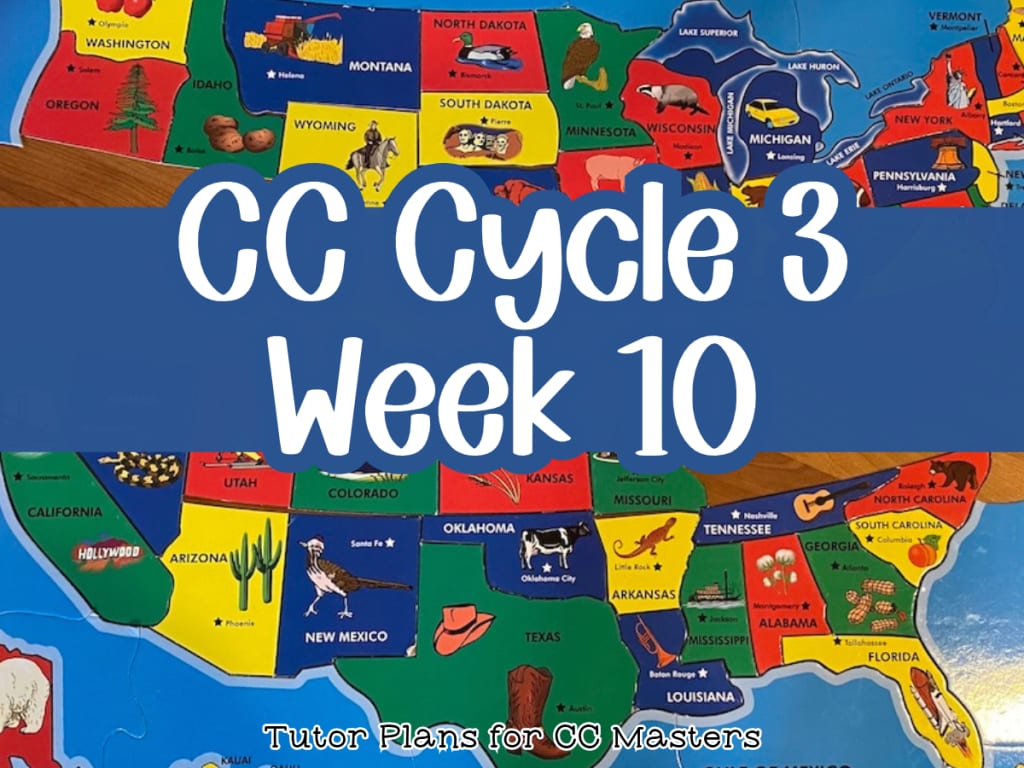
For review this week, I plan to have the class do a state puzzle competition.
Since it is the last week we are being introduced to the states and capitals, I will have them race to complete a puzzle.
Rather than buy two of the same puzzles, I plan to break the floor puzzle that I have into two sections with equal amount of pieces.
Because the eastern half of the US has smaller pieces than the western half, I plan to cut the puzzle in half from north to south.
It won’t be perfect, since the northeast has smaller pieces, but it seems more fair than an east to west split.
Plus, my floor puzzle doesn’t have all of the northeastern states to their own puzzle piece.

Break your puzzle up however best you see fit.
I will split the class into two teams and give each team one half of the puzzle.
They will get 10 seconds to lay their pieces out in front of them, turn around, and then I will start asking review questions.
I plan to ask all 7 weeks of each subject before giving them 10 seconds to work on their puzzles.
For example, after the 10 seconds of laying their pieces out, I will have them turn around so they can’t see their pieces.
I will ask week 4 – week 10 of history songs.
Then I will give them 10 seconds to put together as many pieces as they can.
Have them turn around again and repeat for all of the other subjects.
Add more time if your puzzle has more puzzle pieces. My puzzle only has 51 and they are all large pieces in the shape of the state.
Supplies needed for State Puzzle Competition:
- One puzzle split in half
- Two ziplock bags to hold a half a puzzle each
Save These Masters Tutors Ideas for Later
If you have a masters class for Classical Conversations this year, make sure to save this plan to reference during your CC Cycle 3 Week 10 tutor planning!